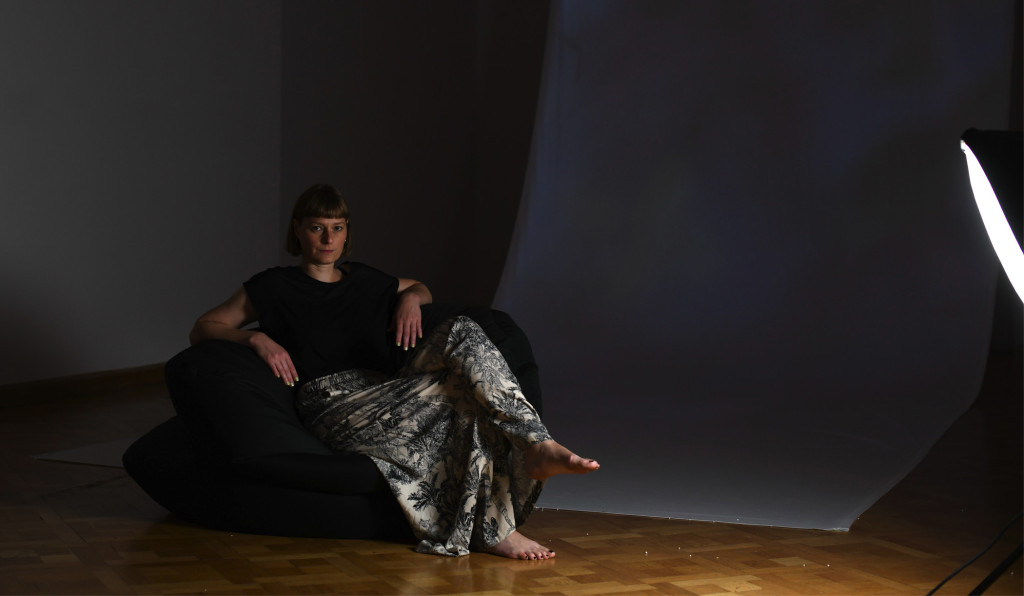
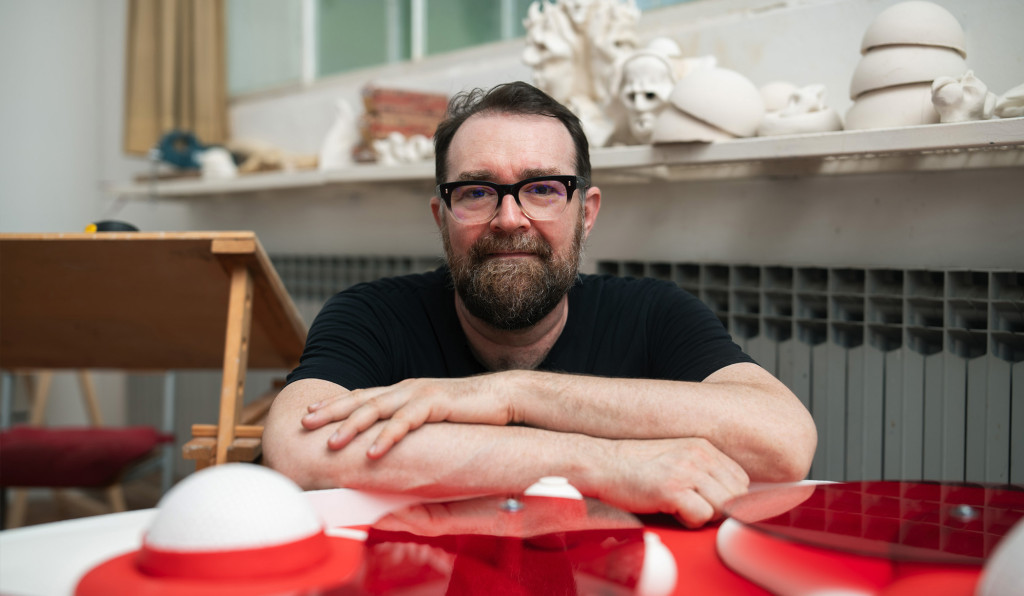
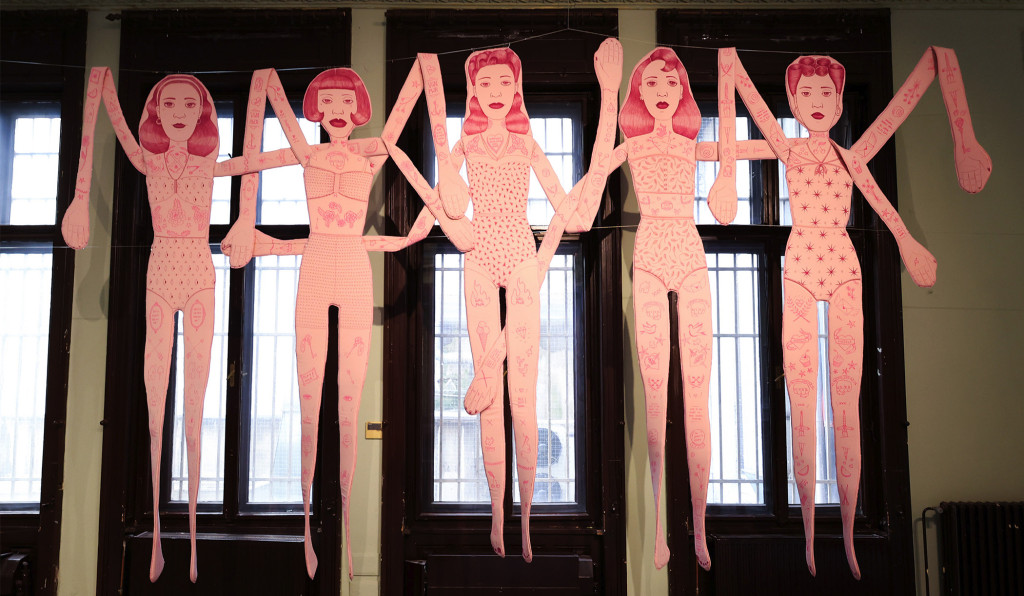
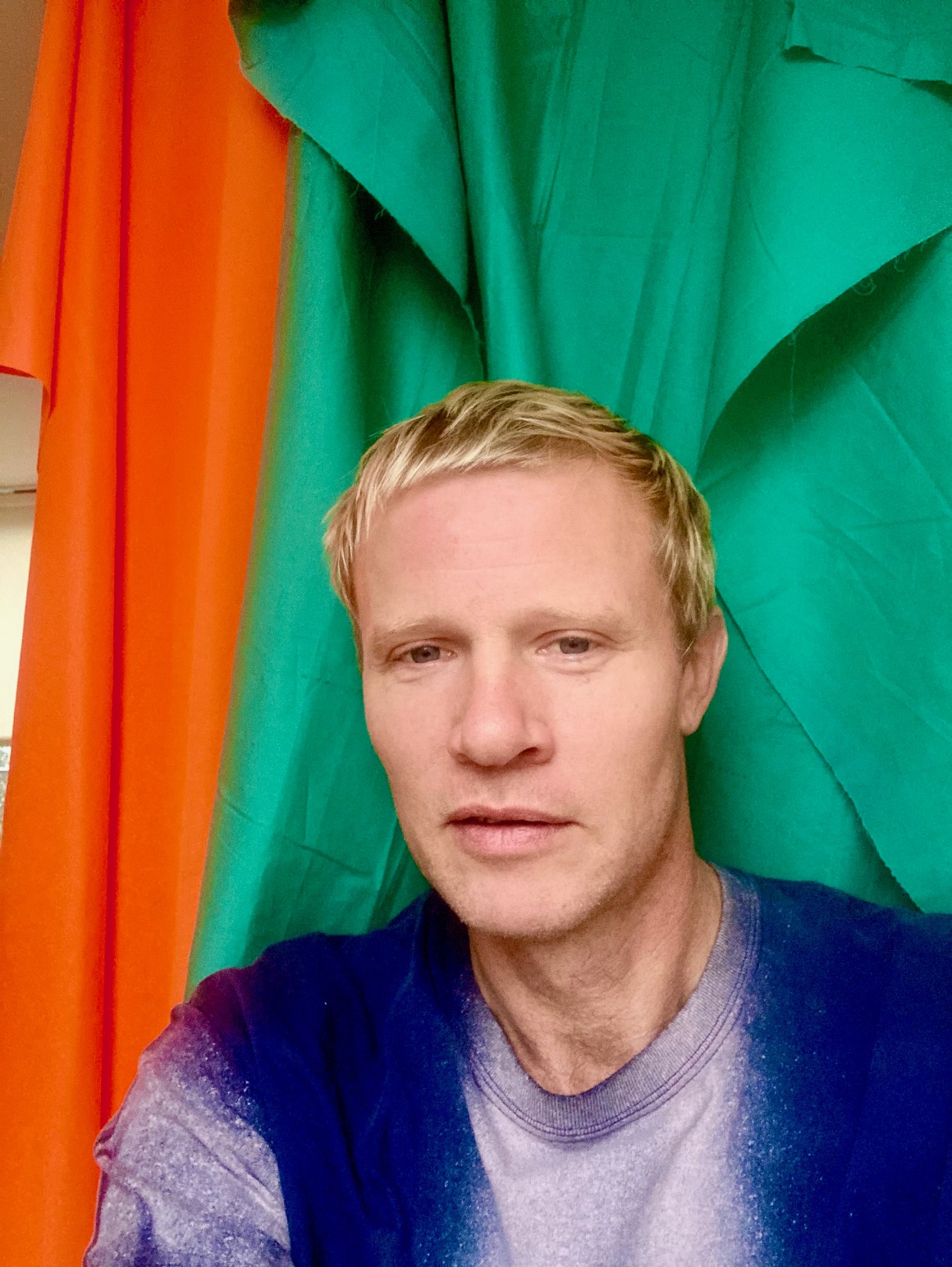
Ben Cain is a contemporary British artist who lives and works in London and Zagreb. Born in 1975 in Leeds, UK, he completed his undergraduate study of interactive arts (cum laude) at Metropolitan University in Manchester and then enrolled in professional university studies at the Jan van Eyck Akademie and the Postgraduate Centre for Art, Design and Theory in Maastricht, the Netherlands. He currently teaches at London’s Metropolitan University and Central Saint Martins. He has participated in numerous group and solo exhibitions and exhibited in international institutions such as Manifesto 9, Genk; Weils, Brussels; Turner Contemporary, Margate, Supplement Gallery, ICA, London; Forum Gallery, Greta Gallery, Zagreb; Busan Biennale, South Korea. With Tina Gverović, he realized works for the Croatian Pavilion at the 57th Venice Biennale, and KM – Kunstlerhaus, Graz.
Ben Cain’s artistic work is marked by the broad media spectrum in which he creates, which includes installation, sculpture, photography, video, performance, text and sound. Common to all these media forms are minimalism and materially discrete audiovisuality through which the author shapes the themes of industrial production, material and immaterial work, the process of commodification and their relationship to artistic production and the social environment. These themes were adapted in this year’s Biennial of Industrial Art Ride into the Sun by curators Gerald Matt, Branka Benčić and Christian Oxenius. The multi-local exhibition brought together a number of renowned artists, including Ben Cain, which marks another motive for this interview.
*Ben Cain
► Recently your works have been shown in Apoteka in Vodnjan, Art radionica Lazareti in Dubrovnik and on Industrial Art Biennale in Labin. They revolve around labour and its transformations, artistic action, leisure and work, themes you usually deal with in your practice. How did you respond to the theme of Biennale – Ride into the Sun – and to the specific local contexts of Labin, Raša and Pula where you exhibited?
Ben Cain: Riding into the Sun suggests to me being blinded by the light, transfixed, embracing a hot future, being uncontrollably drawn zombie-like towards something (I’m reminded of Margaret Thatcher’s horror phrase: there is no alternative), tackling and challenging the inevitable – this might be careless, or/and it might be courageous. When I think about earlier forms of work culture being healthier, I don’t think I’m being nostalgic. I’m thinking about worker’s rights, unity and equality between workers, the possibility of taking pride in ones’ work… This is perhaps part Yugo-fantasy, but there are also truths here that chime with my own experiences of growing up in the industrial (and post-industrial) heart of the UK. My work is concerned with the contemporary landscape of industry and commerce and its relationship with art, and my discomfort with over-professionalised and conservative “creative industry”. The mine in Raša and the accompanying social infrastructure that foreground leisure and communal activity made me think about how certain types of work and associated work culture might promote collective interests or private interests. But binary thinking never works – the work that I made here isn’t for example about pitting private interest against collective interest, one political system against another, its rather about the pulls and overlaps between the two. In the 1920’s/30’s the USSR five-year-plans celebrated a super-productive mode of working labelled shock-work, a work mode which is strangely familiar in the present-day capitalism, the point being that there are overlaps even in very different political systems – this is outlined very clearly in Susan Busk-Morss’ book Dreamworld and Catastrophe: The Passing of Utopia in East and West. The works that I’ve made re-imagine the locations where the work is sited as places where future-fictional people still work – shoes are left in a line and coats on hangers, tools on a rack, signs of workers dressing and undressing on the way in/out of work. But the works are also introduced as fashion commodities, and so the immediate environment then becomes a shop rather than a place of production and creation. So there’s an overlap between luxury goods and the idea of collective action – is this a contradiction? The works envisage different work forces, different teams, and in turn perhaps different types of work? What sorts of work might be associated with these garments, if any!?
I start with some constants that you’ve mentioned in the question above, e.g. work, leisure, taking pleasure in fabrics and forms and colours, ideas about contemporary types of ‘production’. One of the first things I did when developing this work was to visit a number of local fabricators that have strong links with the history of labour in the area. For example, we had a lot of conversations with a couple of large ceramics studios in Raša about potential cooperation, but unfortunately it didn’t work out. I think about what industry has been replaced by, and about the potential future of labour and production in the area.
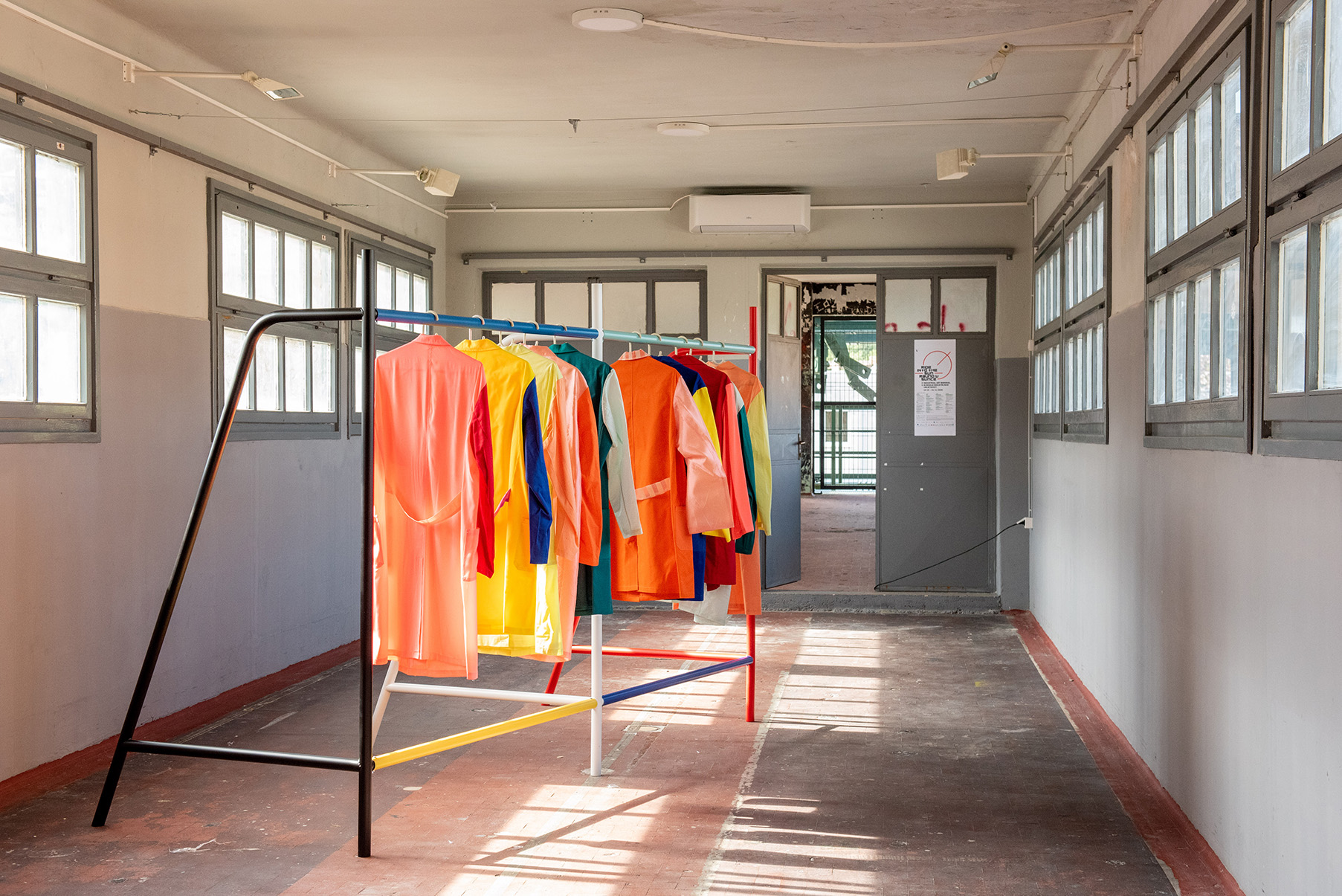
*Ben Cain, “The New World of Work (body)”, Industrial Art Biennale, Labin, 2020. / photo: Mateo Gobo
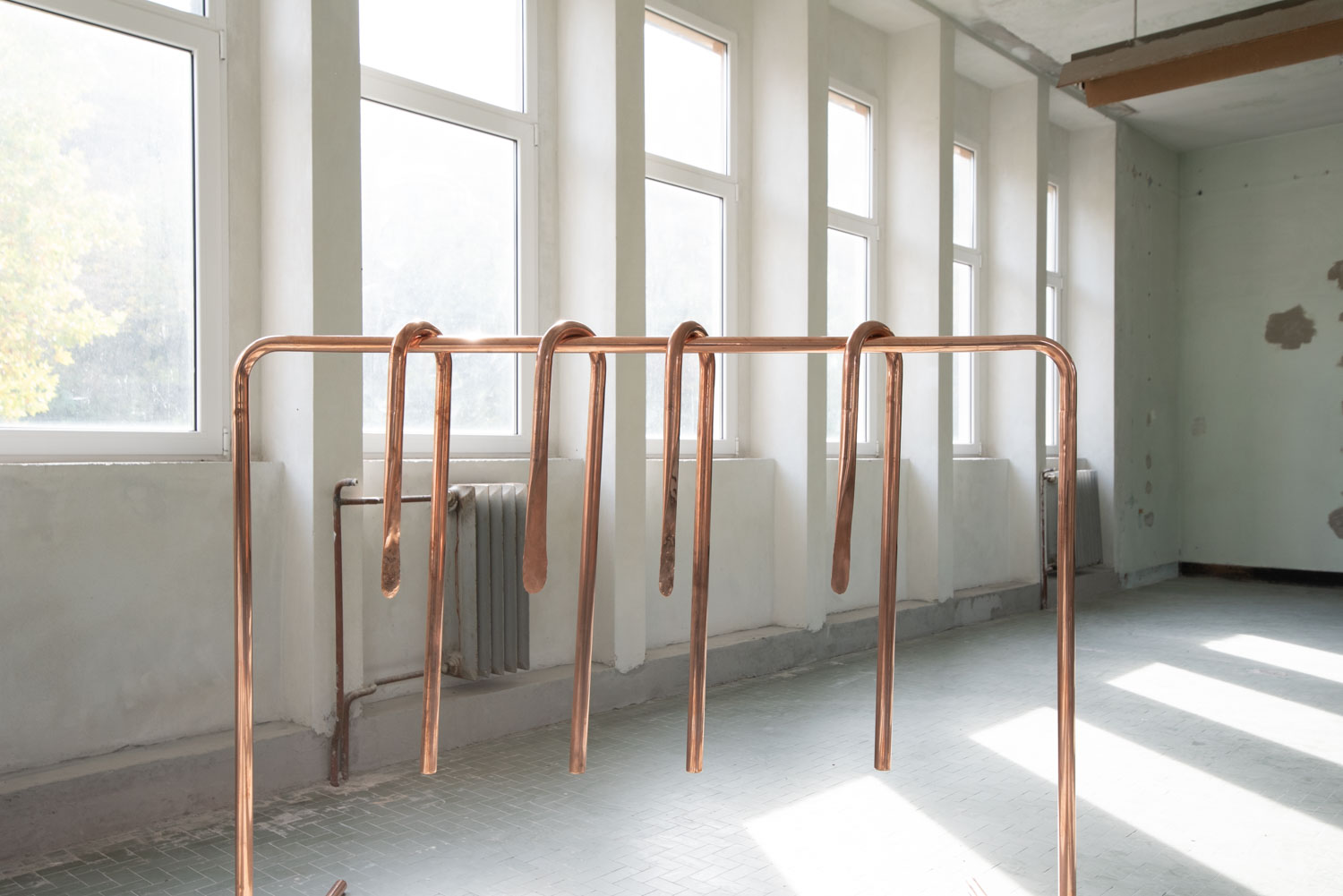
*Ben Cain, “The New World of Work (extra limbs)”, Industrial Art Biennale, Raša, 2020. / photo: Mateo Gobo
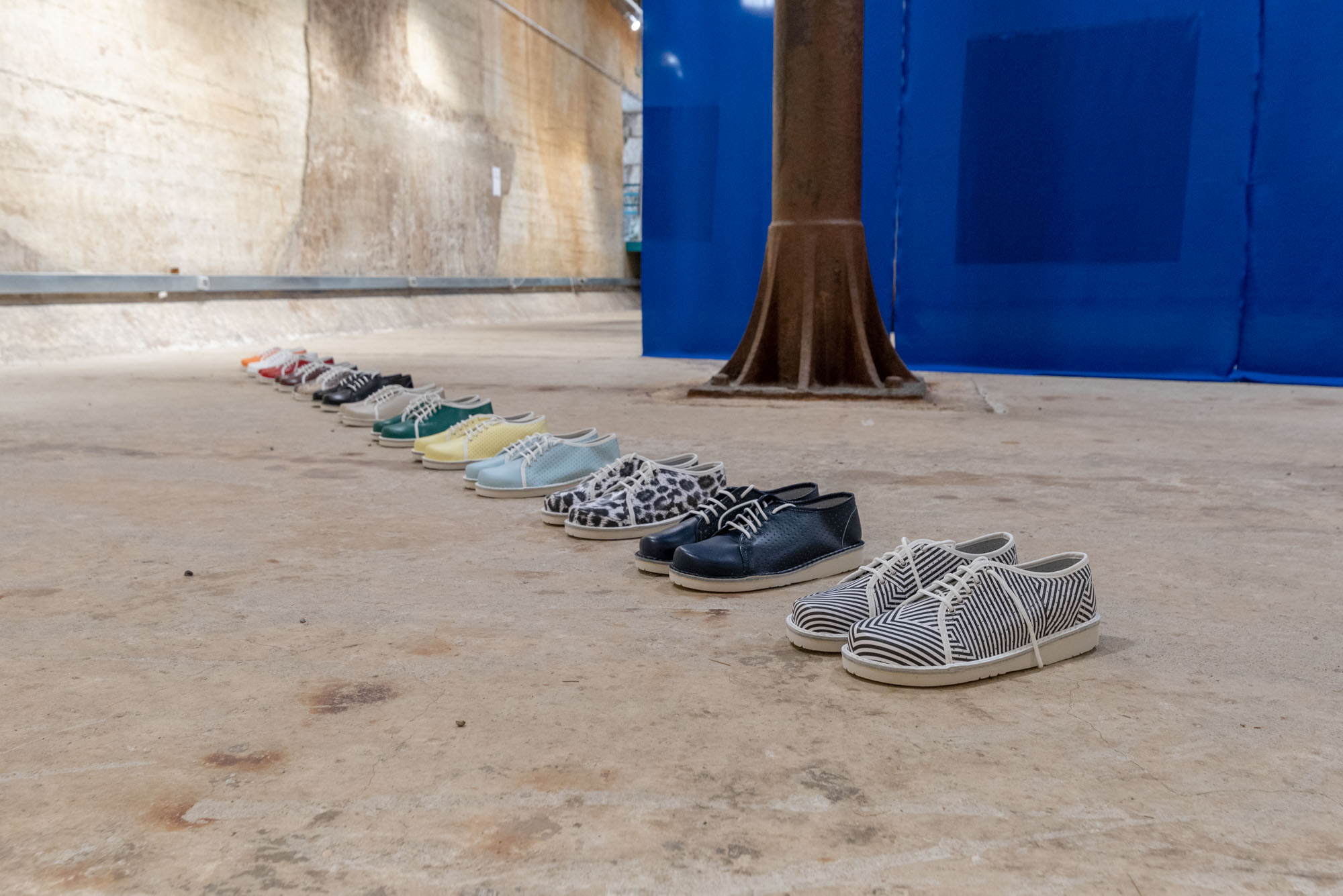
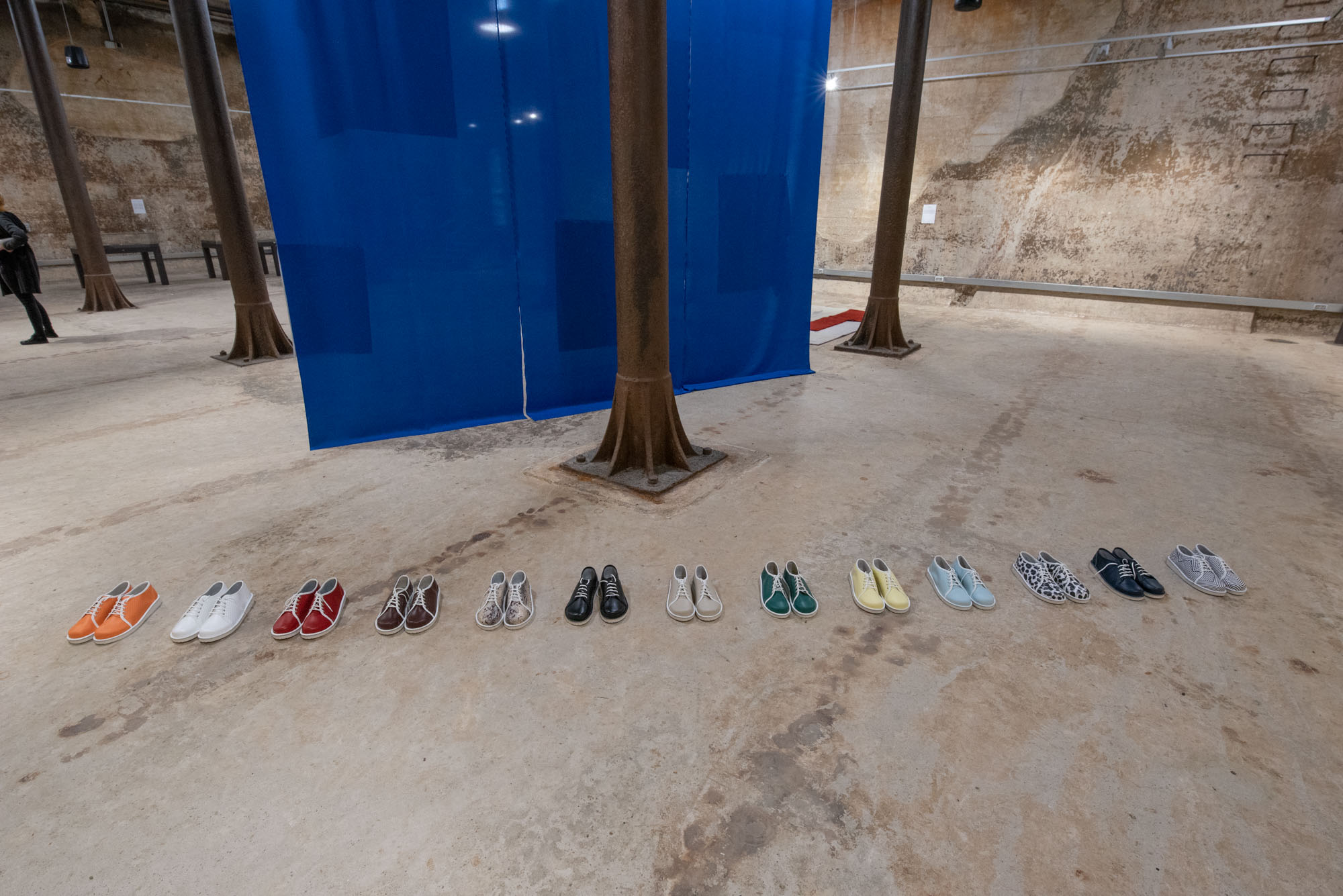
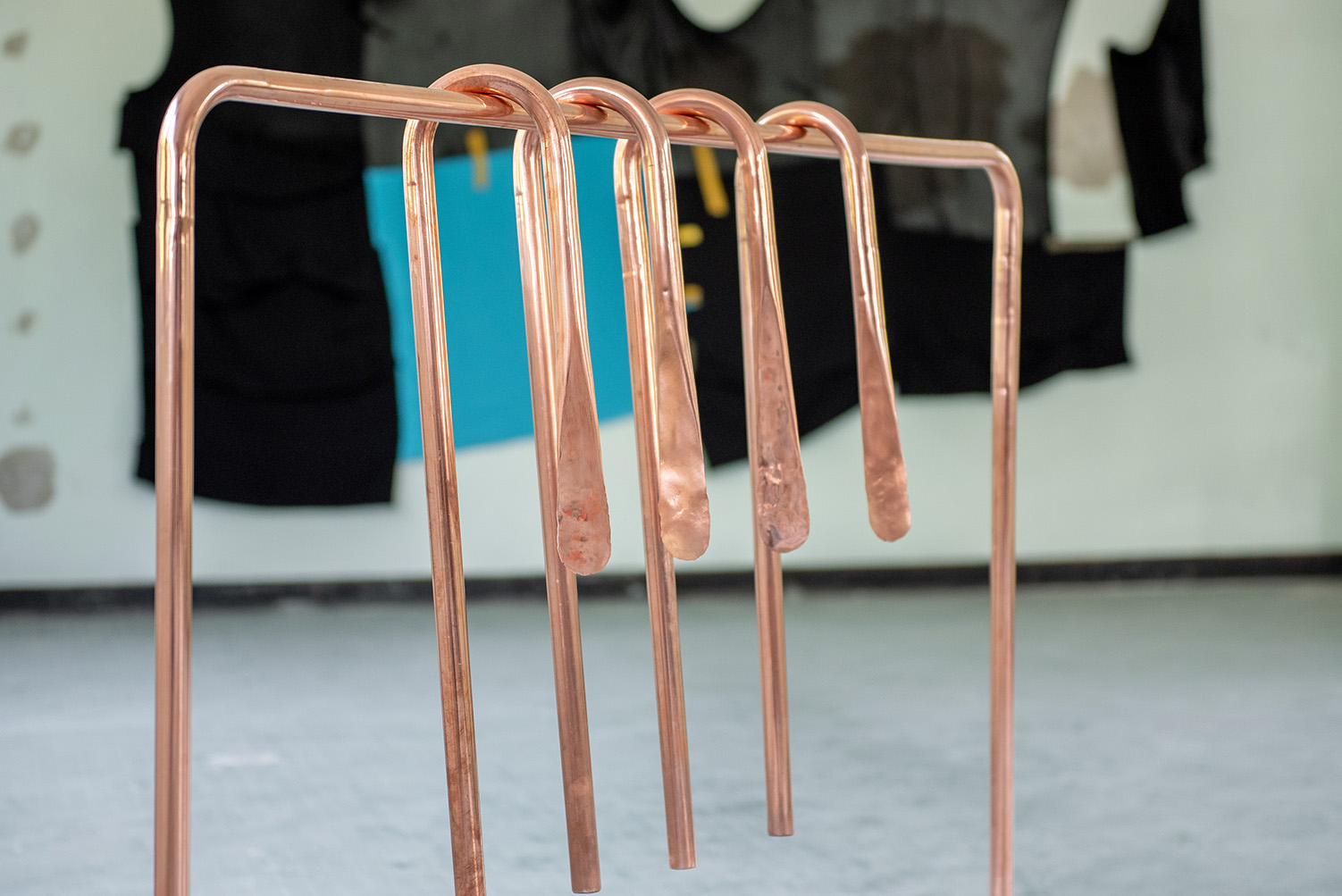
*Ben Cain, “The New World of Work (feet)”, Industrial Art Biennale, Pula, 2020. / photo: Mateo Gobo
► Living in Zagreb and London, you work and exhibit in various venues. What is the role of larger gallery-museum institutions in the production and reception of contemporary art practices when the activities of the independent art scene are much more visible and often more agile? Which characteristics would you point out when we speak about the contexts od UK and Croatia? What new resources should contemporary arts venue offer to remain useful to the public which they serve?
Ben Cain: I think it’s probably true that the independent art scene in Zagreb is more agile and visible, but that’s not necessarily always the case in London – depends who you’re asking, I guess, and which institutions are in question. The Labin Biennale is a large institution, but on this occasion through working with smaller multiple venues and events it’s acted in a more agile manner. Larger institutions can sometimes act like smaller orgs, and vice versa. It’s important for both to embrace the possibility of chameleon-like character according to societal and economic shifts, but sadly larger institutions seem to find that hard. Ordinarily I’d say that larger institutions have a responsibility to support artist’s development long-term through offering significant production resources, paying real-world wages, but what artists want and need is also a meaningful critical discourse with that institution that evolves and deepens over time, i.e. proper care on financial and intellectual levels, as well as respect for artistic labour, and this is what we should expect from large or small organisations.
In terms of differences in context between Zagreb and London, I can only talk from my perspective, and in terms of how Zagreb feels to me -although I know it really well now- that’s a position that involves some degree of alien’s privilege. For me in Zagreb there’s less space between making and showing work, things can be fabricated more easily and spaces and events can be organised more easily too. The gap between producing and transmitting is smaller and I like that as it suits a way of working that’s keen to share ideas and forms as they evolve, there’s a spontaneity that’s a bit more adhoc and haphazard (but I might be describing the quality of my work, rather than a scene). I’m also influenced by a climate of expediency, and by the strong presence of actions, events, performance and theatre from the 1950’s onwards. The fact that there’s no market is a double-edged sword, but on one hand it does help to nurture a sense of having less to lose, and along with that a less competitive and more caring community – the sense of freedom and support that comes with that is really precious.
It’s important to think about creating publics as much as “serving” them. There are lots of different publics, lots of different demographics, but generally I feel that the public can (or should have to!?) deal with a lot more than they’re generally offered. I know that the commitment to ‘the public’ is perhaps quite different for smaller or larger arts organisations because of questions related to public and private funding and audience numbers; however there’s always a basic requirement to foster and nurture communities, to foreground the marginalised, to expand and radically reset notions of what’s understood as normal or acceptable, but at present its difficult not to think that any arts org needs primarily to address the ways in which racism, fascism, individualism, and commerce destroy solidarity, interdependence, health and ecology.
Meanwhile, Tina Gverović, Siniša Ilić and myself recently set up a small nomadic semi-virtual gallery and the basic drive for this was friendship together with a need to maintain and establish new links with people over distance at a time of social isolation – we were thinking about what we need, not what a potential public might need. Being socially-minded doesn’t mean you can’t also forget about the public sometimes. This gallery, only available on Instagram, is an extension of a gallery that Tina and I set up in our flat in Zagreb. This was (and will be again) a space that operated through familial relations, and in this sense it might be thought of as exclusive, but it also managed to share art in an informal manner, to bypass bureaucratic constraints, let in the care-free, and to cement and expand a network of friends.
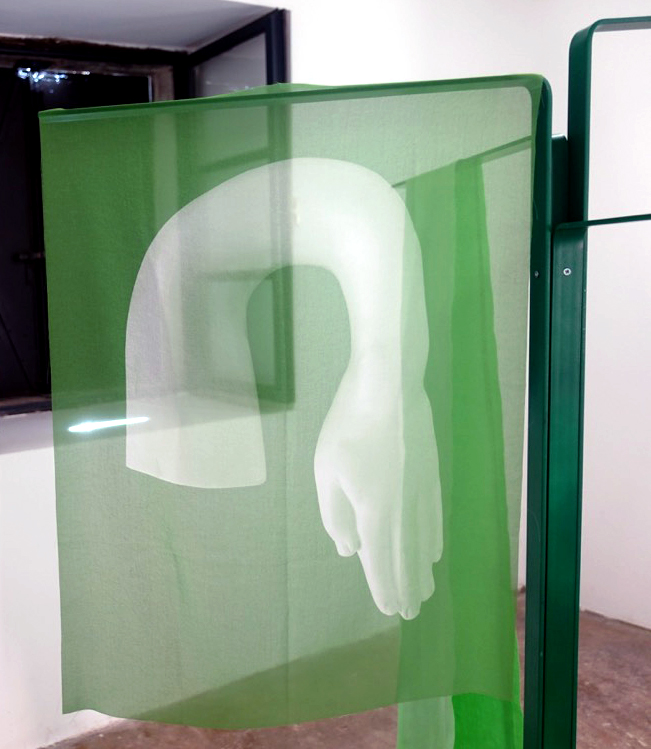
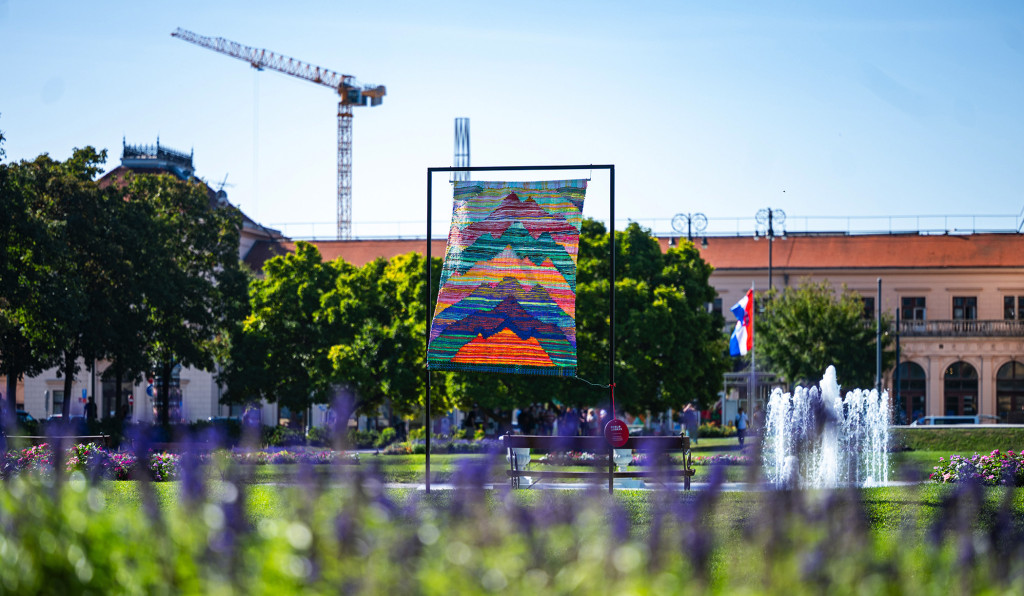
*Ben Cain, “Small Subject Factory”, print on fabric, powder-coated metal structure, Apoteka, 2018
► Your artistic practice unfolds across many levels, including sculptures, installations, videos, performances, language-based works, publications, interactions and interventions. How do you choose medium in which you work?
Ben Cain: Its determined by what’s to-hand, what’s local, what’s available, and by what seems most appropriate for a certain context. Often it’s a mix of all these elements. Sometimes I’ll use a medium because I know nothing about it, and often I’ll work with a certain medium because it means I’ll be able to work with a new group of people or a specific person. The language or script that I use might be something that’s associated with certain production processes, i.e. the social material or culture that surrounds a thing or a technique. Sometimes it’s a case of buying some products in the local supermarket and bringing them next door to the gallery where I can represent them alongside other objects and text.
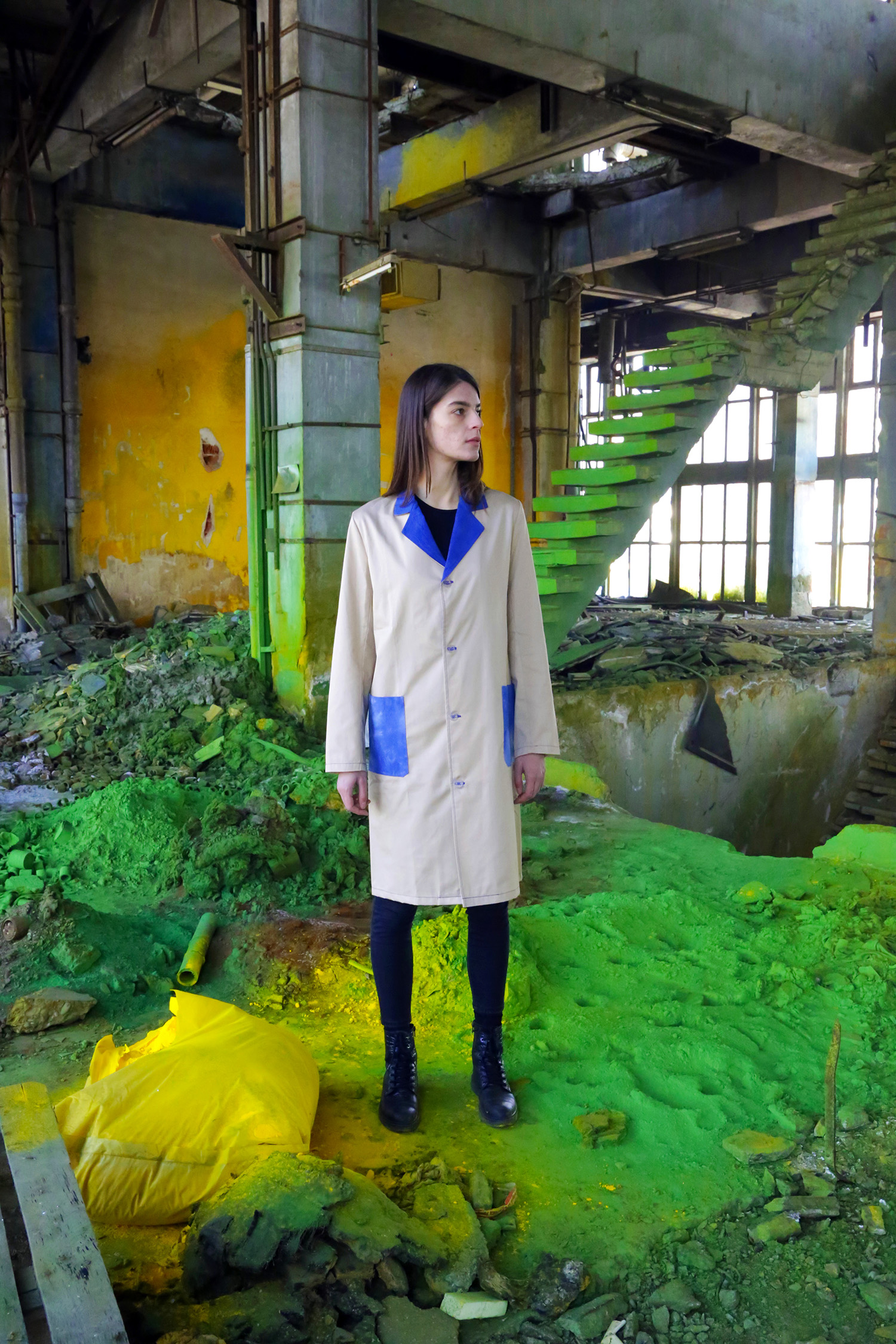
*Ben Cain, “Post-Work-Work-Wear (Meri in Chromos #2)”, image printed on white denim (100 x 220m), 2019. original image by Sanja Bistričić/Ben Cain. modelled by Meri Ćurić.
► In your artistic work you are concerned with ideas of participation, collaboration and interactivity – which is highly visible in your book from 2019. Uses of Leisure. You collaborate with other artists, but also with dancers, actors, philosophers, designers… You also developed certain projects in student-mentor constellation, since you teach on undergraduate and postgraduate Fine Art courses at the School of Art, Architecture and Designof London Metropolitan University. As you once asked Tina Gverović and Siniša Ilić in an interview you did with them: Working alone and working together, what is participatory experience and what does it do to art? What are the differences between making your own work and making collaborative work – how do you approach each process?
Ben Cain: I’m really drawn to the collective effort, where it’s the sum of the parts that counts, which is partly why I really love working in theatre. Collaboration might be about stepping away from something known and familiar, but there might be a degree of that sort of stepping away that’s encountered through contact with inanimate materials as much as with people (Timothy wrote about solidarity with nonhuman beings). On some level looking at art is about participating, or even collaborating, a merging with someone or something else? Most of what I’m working on focuses on relations and relationality, it’s about setting up situations that pose this question: what’s participation and is it happening right now, as we speak? What is active participation? And what is non-active participation? I’m not so interested in communicating clear ideas. I enjoy productive confusion, strange exchange and discourse that’s not always straight forward. Therefore I’m drawn to working situations that involve types of contact between people and things that challenge what I know. The short answer is that I think I approach working independently and working collaboratively in the same way, they’re both about negotiation, compromise, loosing yourself, and making leaps of faith.
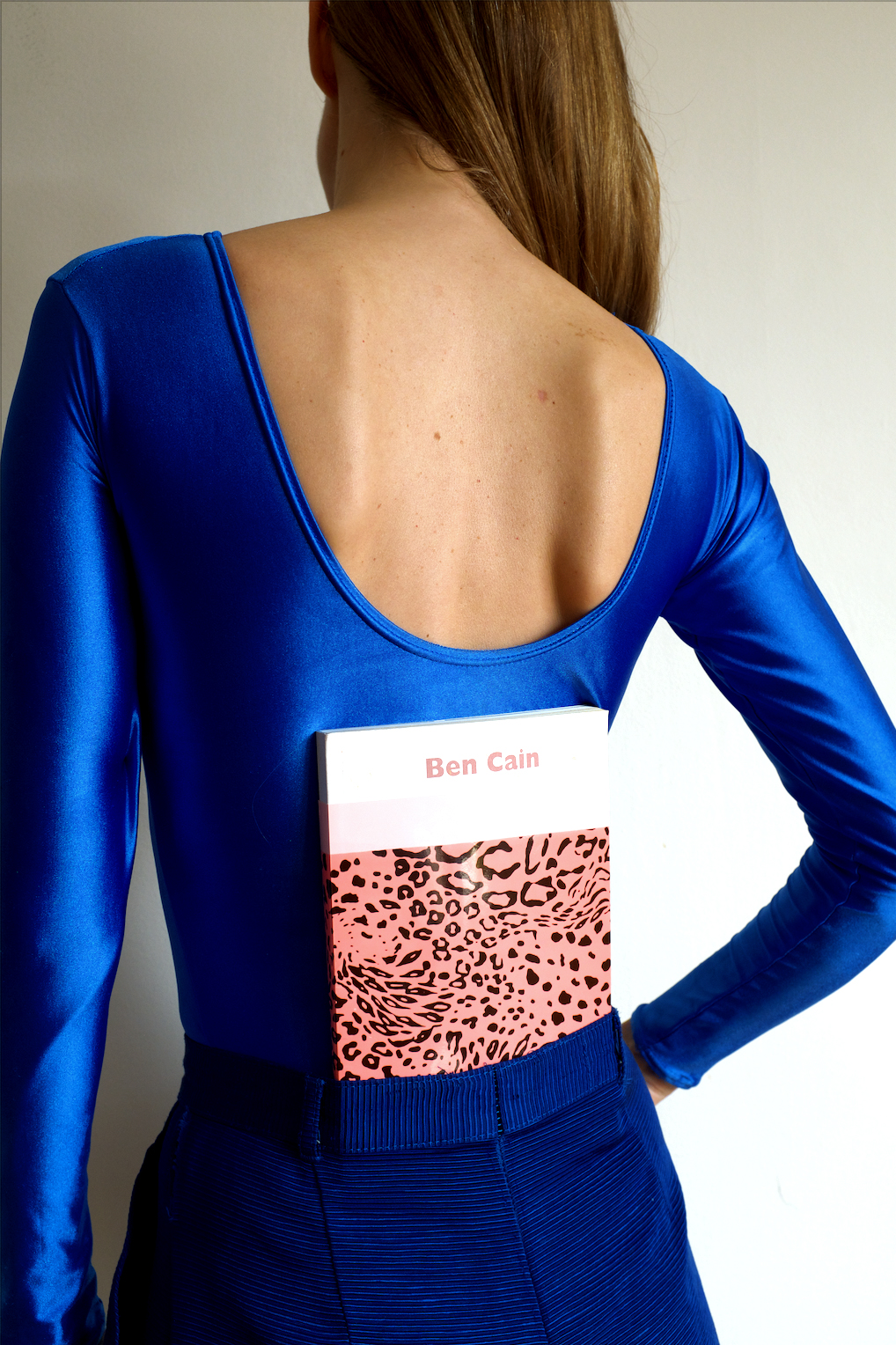
*Ben Cain, “Uses of Leisure”, images developed the book presentations (Wiels, Brussels), 2020. image by Erika Wall and Patrick Lacey
► Words, narratives, language and its relation to objects is also one of recurring themes in your artistic practice. Limits of words, of language and its relationship with objects which creates our reality. In your work We’re here because of you you use Croatian words, and in your book Uses of Leisure you use Croatian alphabet as index. How do you relate to Croatian language in your works? Also, to refer to your recent exhibition Manual Language and its text, what are the words you do not have yet?* What are the words that society needs today?
Ben Cain: I often use words as a type of ventriloquism, also called throwing your voice, thus making it seem as if inanimate materials can “speak”. An object is an intermediary. Object-oriented philosophy and speculative realism have had an effect upon me even if I’m sceptical about some of these ideas. I think I know that inanimate materials can’t talk, but they can “say” things. It’s a question of affect. If we can be moved by things, materials, in-animates, non-humans, perceptual information, and think of these as allies and companions we can move away from a human-centric understanding of the world and develop empathy across species and materials, developing responsibility beyond the personal?
Most of the words that I try to put into the non-existent mouths of objects and materials try to generate relationships, asking audiences to think about the nature of the relationships between themselves and the art works, or objects. Those objects might be both dependent and independent objects, and their character might be defined by a struggle between their own internally defined histories, origins and critical perspectives and those that are imposed externally by us. It’s a space of generating something, meaning? narrative? The give and take between projecting an idea or feeling and receiving it that I return to.
In relation to missing words… We desperately need a vocabulary that involves racial literacy, and that’s been the case for a long time. Audre Lorde was talking from the position of a Black, lesbian, mother, warrior, poet, and this position, or positions might demand a number of literacies or vocabularies. When I made this work I was really moved by Lorde’s writing, and whilst the exhibition that I made at this time is about missing words and the ensuing gaps between people but also between things, as a friend pointed out it’s maybe also about loneliness.
Patrick Lacey (working as studio Abake), with whom I work with a lot, decided to use the Croatian alphabet index – I asked him for a couple of words:
I had been teaching a course with Ben in a small Italian town for a week. We had an early flight back to the UK and needed to take a cab to the nearest train station. We negotiated a price with a taxi driver who spoke broken English with a heavy accent. A short way into the journey I realised Ben was conversing fluently in a language I didn’t recognise. This continued for the hour-long drive, punctuated with laughter and some solemnity I gathered from the tone. I felt impressed and excluded at the same time.
Ben has an accent that initially makes him seem European but later when you discover he is from Leeds it also makes sense, he is also very English. What is English? To define that is difficult but in this case I think it has something to do with fair play and boy-ishness. In typographical terms it’s much easier: Gill Sans, a typeface that is used by many British institutions and which Ben has used often in his own practice.
When organising Ben’s diverse works from the last ten years we arbitrarily gave each project an alphabetical reference that takes the reader to an index of texts by different authors and the artist. We had thirty works; too many for the English alphabet but just enough for Croatian. Our version of Gill sans was lacking so we added the missing diacritics, or accents.
Ben’s work makes me feel a bit like I did in the cab; there is a fluency of language meaning and humour – parts of which I understand and parts which are forms I recognise without comprehension, but I keep looking to the index.
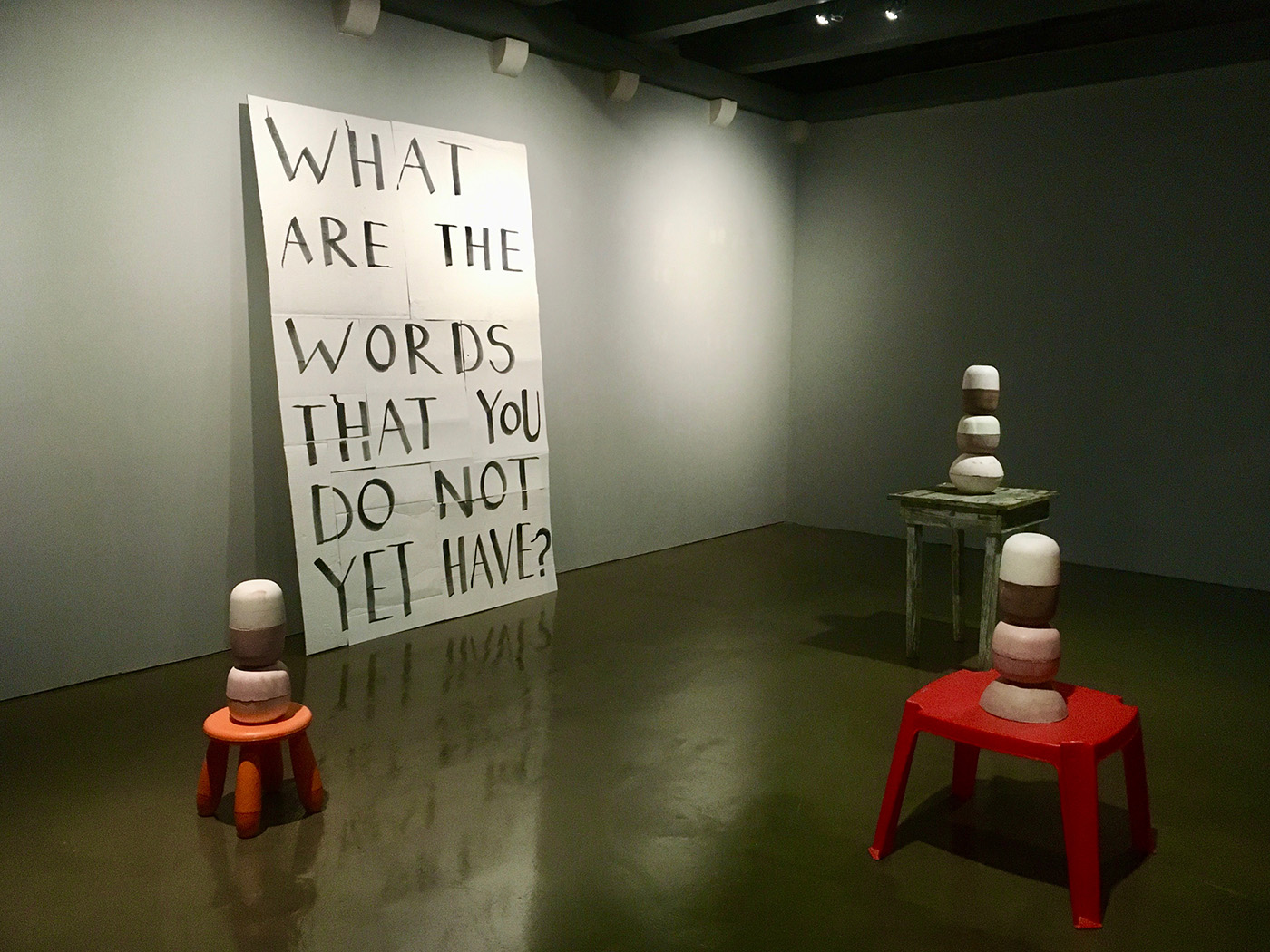
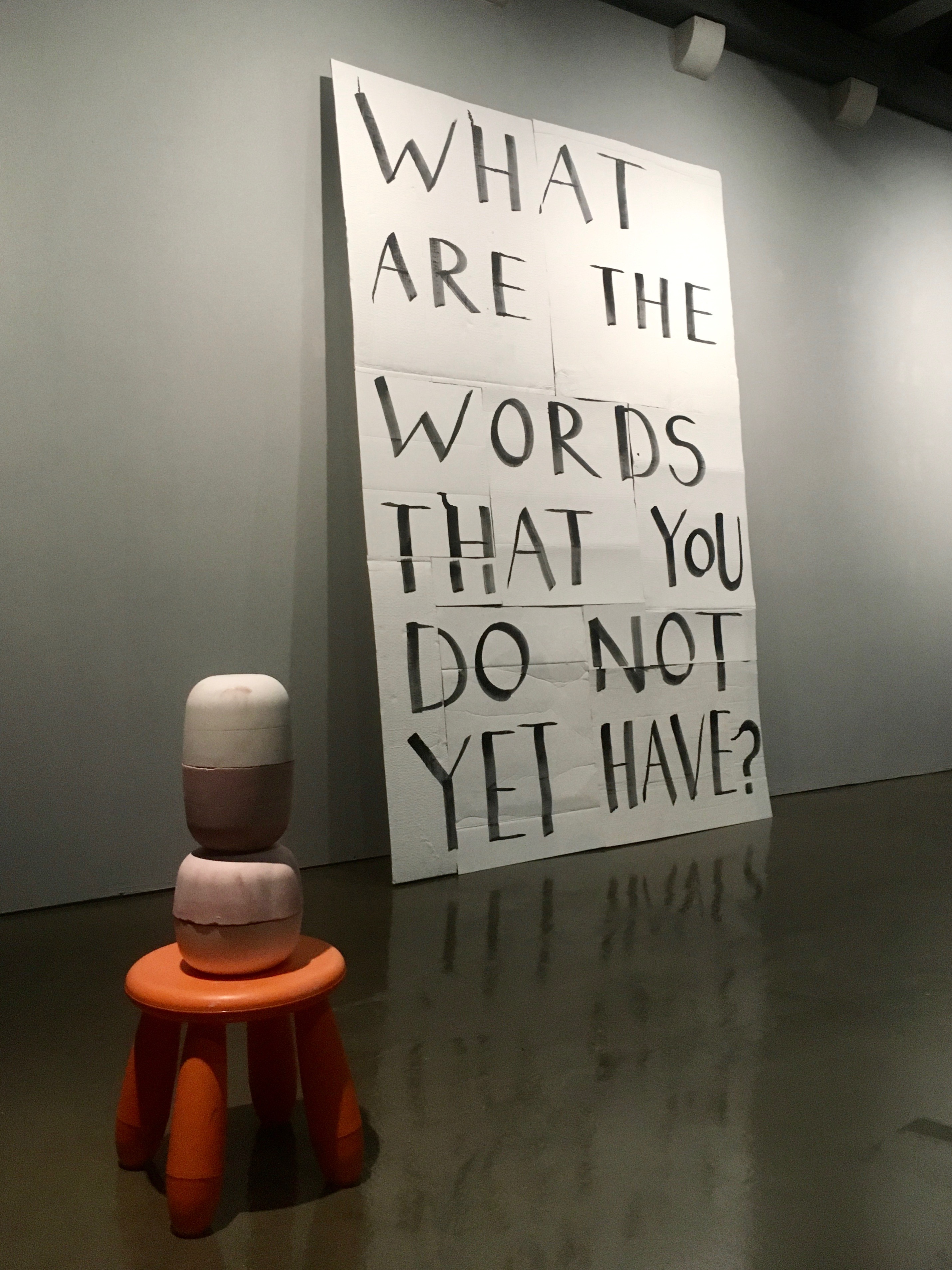
*Ben Cain, “What Words?”, ink on cardboard, found furniture, plaster, paint, pigment, bamboo, ARL Dubrovnik, 2020
► The role of spectators, of public in social and cultural production manifests through relations to objects, to space, to viewers and to what is viewed. How is the act of receiving or viewing art entangled in the process of producing that art? Is it also a form of immaterial labour?
Ben Cain: Yes, the Immaterial Labour of art viewing! Neo-Liberal labour is the sort of labour that we don’t want to do. When is art-viewing the sort of labour that we don’t want to do? Non-stop participating is tiring? When we’re asked to offer “feedback” all the time and to participate according to predetermined rules we want instead art-related experiences that don’t leave us with dull instrumentalised roles. Art viewing always involves production – when you look you project, you interpret, and you generate ideas (emotions are ideas too), and of course that becomes a problem when we’re – rightly – hypersensitive to a demand to over produce all the time. Whatever you’re looking at informs you, but you also inform it of course.
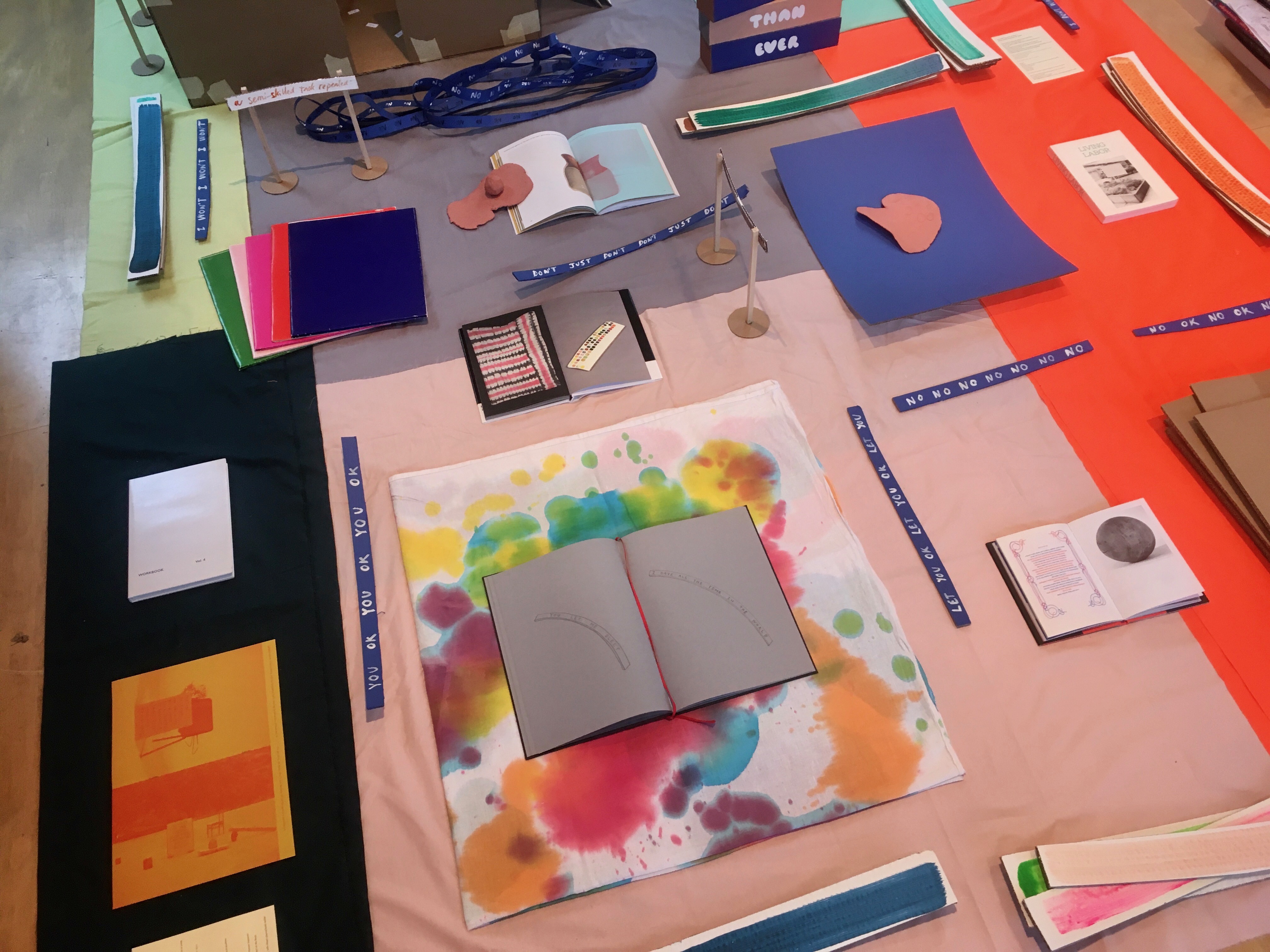
*Ben Cain, “No Action Only Talking”, video (available online) and installation, mixed media. spoken by Francesco Pedraglio. made for a workshop at ISIA Urbino, 2020
► As it was previously said, your artistic practice revolves mostly about the themes of labour, work and leisure. Legacies of industrial past are shaping our future and at the same time new conditions of work ensue. Socio-economic conditions require new ways of living and working in which leisure and work, personal and working life collide. What is contemporary work culture? Is art yet another resource and what is its position in this socio-economic system?
Ben Cain: You’ve very nicely rounded-off the interview with pin-pointing the questions that often lay at the core of the work! The conditions of work have changed so drastically and so rapidly during the last 30 years or so, as have the social roles and daily activities of an artist. From craft-based to mass production, to service industry, to cognitive and immaterial labour – I find that my work is an amalgamation of these different modes of interacting with and affecting the world.
COVID-19 has brought even less of a distinction between work and non-work, the personal and private, since all the work we do needs to take place in the home alongside all the other types of work we do, and all the pleasures we need such as caring for kids, for each-other, resting, writing, exercising, sex, sleeping, dreaming, drawing, reading, listening, playing, cooking, kissing, cleaning… I think I’m still trying to work out how damaging that lack of distinction might be, but when the work that you don’t particularly want to do starts to demand more and more from you and starts to infiltrate and take precedence over your health, relationships, the work that you do want to do… there will be casualties. What are the physical and psychological effects of the liberating new working patterns?
Art can be a resource without it being monetarised, and it can be monetarised without selling out; it can have a use-value and its value can be uselessness. What is contemporary work culture? Typically cruel, often brutal, but there are ways to resist and art is good for that.
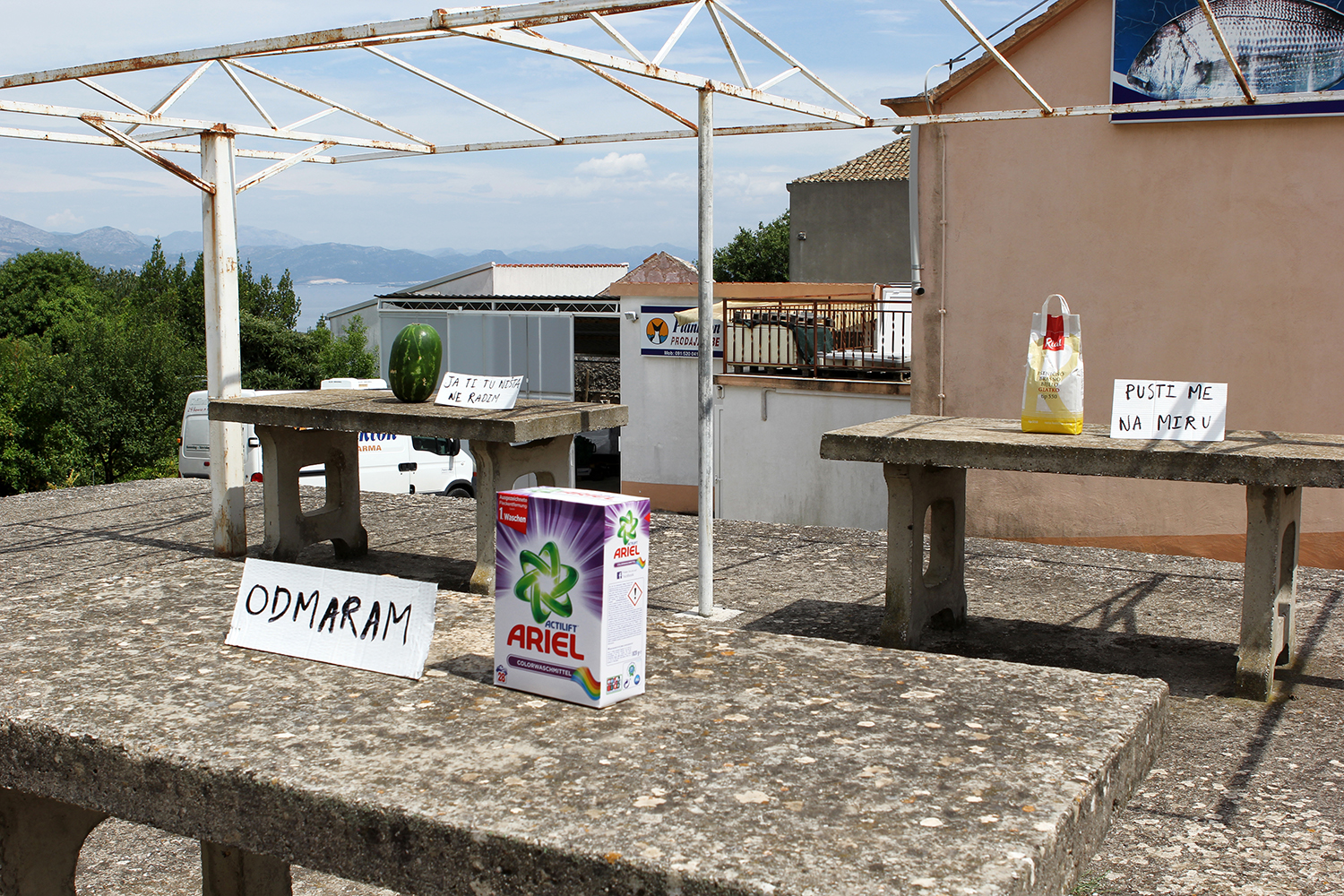
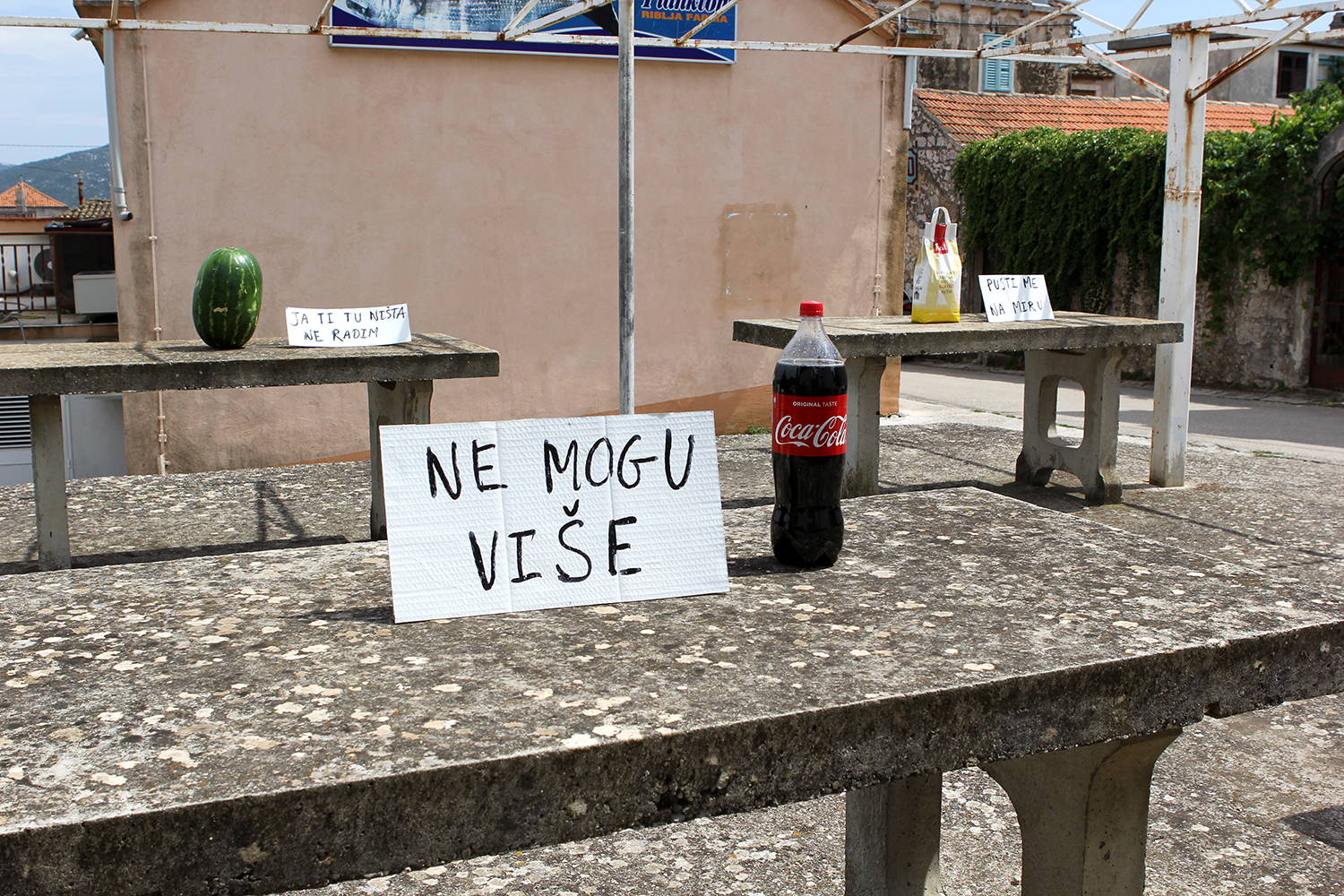
*Ben Cain, “We’re Here Because of You”, (on location) supermarket products, ink on cardboard, Vizura Aperta (Janjina), 2019
*Audre Lorde, The Transformation of Silence into Language and Action, 1977.
*Tekst je dio Vizkulturinog projekta “Vizkulturiranje društva 2020.” koji je sufinanciran sredstvima Fonda za poticanje pluralizma i raznovrsnosti elektroničkih medija Agencije za elektroničke medije